Just telling that you were in the wrong spot isn't always as helpful as it seems. You need to see it, and loading up a replay for every single mistake is quite tedious. That's why we've built a new way to reflect on your positioning and rotation: A top-down map and 3D rendering.
Check your positioning by a top-down map
When the app flags a mistake or an increase in danger, you can now see exactly where you went, and what caused this mistake. The app will also show which line a higher ranked player would have taken, so you can check what you should have done instead.
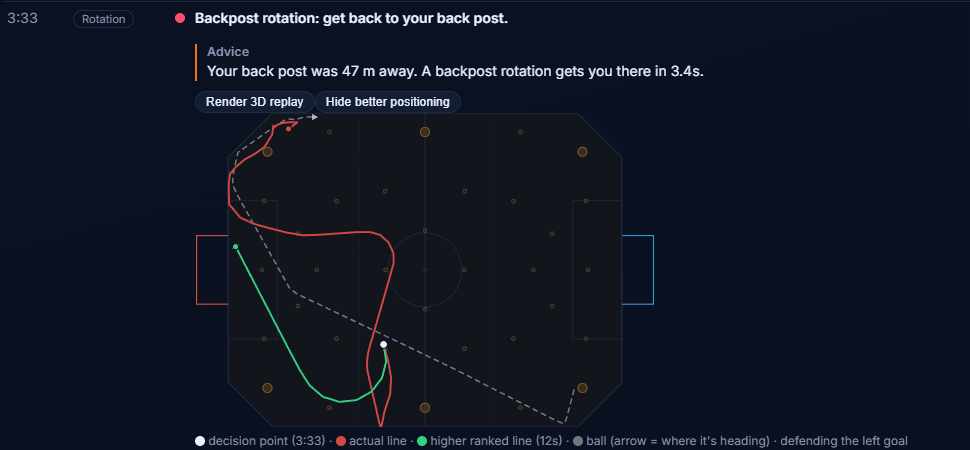
It also puts a number on the alternative: the back post was 47 m away, and a backpost rotation gets you there in 3.4 seconds.
Not detailed enough? Render it in 3D
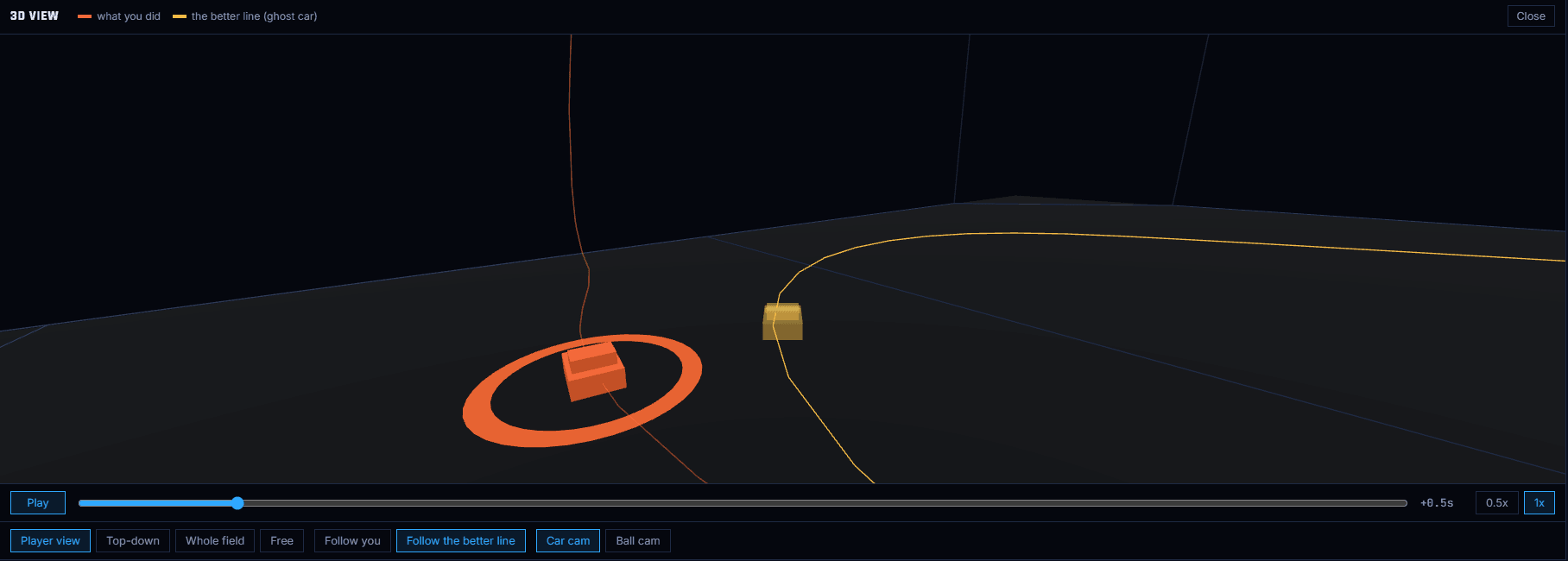
A top-down map is nice for checking your rotation, and getting a quick overview of where everyone went. However, comparing it to a third person moment within the game, and seeing what your car sees, would be even better. That's why we've added a 3D rendering agent to WhiffLess, allowing you to watch back every moment, just like you were in the game.
How are the better lines determined?
The better lines are determined through a neural network we've developed ourselves. The type of network is called a Conditional Variational Autoencoder (CVAE). The most famous example of a normal VAE is AI image generation, which you've probably seen in action countless of times. We've adapted the structure of this network to work using Rocket League replays as input, and we've trained it on litterally millions of in-game moments.
Now you might be wondering: But you said conditional VAE, not just VAE, where does the conditional part come in? That's the state of the game for each frame, together with the rank you've indicated you are. The condition constraints the model to take into account the state of the game and your rank, so it can generate a better line that is relevant to your rank and position.
How well does the model perform?
The model performs okay from the first test outputs. Of course, the model will be refined countless of times, and by the time WhiffLess officially releases, it will generate much better paths than it does right now. The results already look promising, but they aren't always correct just yet.